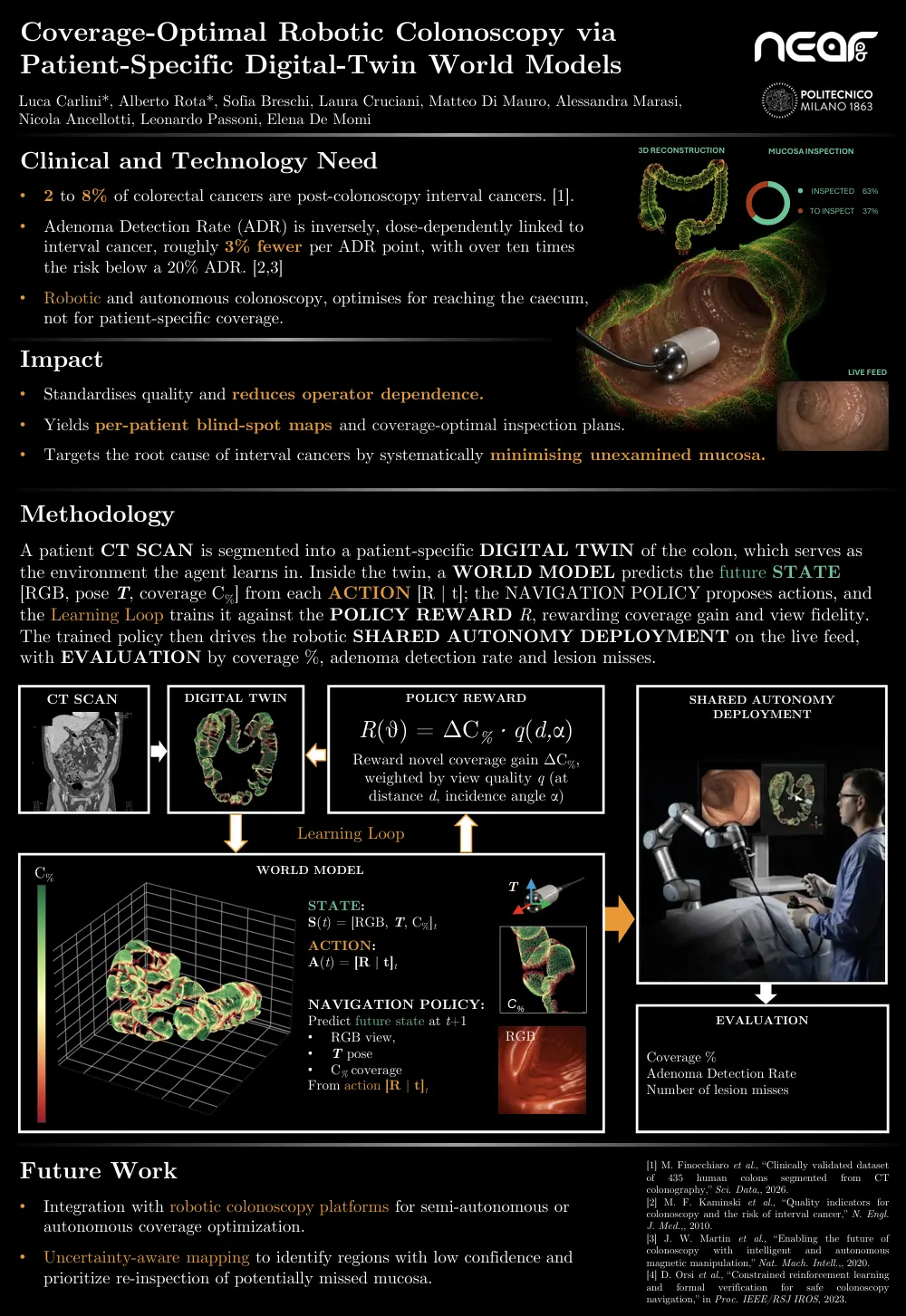
Robotic Colonoscopy
Patient-specific digital-twin world models
- World Models
- Digital Twin
- Colonoscopy
- venue
- Hamlyn Symposium · Best Poster
- year
- 2026
Abstract
Post-colonoscopy interval cancers account for 2–8% of colorectal cancers, driven primarily by mucosa that goes unexamined during withdrawal. The Adenoma Detection Rate (ADR) is inversely associated with interval-cancer risk, yet current robotic colonoscopy systems optimize for reaching the caecum rather than maximizing patient-specific mucosal coverage. We propose patient-specific digital-twin world models that segment a CT colonography scan into an individualized colon environment where a navigation agent learns coverage-optimal policies rewarded for novel mucosal coverage weighted by view quality.
Introduction
Colonoscopy is the reference test for colorectal-cancer screening, yet interval malignancies emerge when lesions present during examination are missed. ADR is the strongest validated quality indicator and is dose-dependently linked to interval-cancer risk. A primary cause of misses is mucosa hidden behind haustral folds or at flexures. Recent autonomous colonoscopy systems advance locomotion and caecal intubation but do not optimize how completely the colonic surface is inspected, leaving completeness operator-dependent and unmeasured.
Methodology
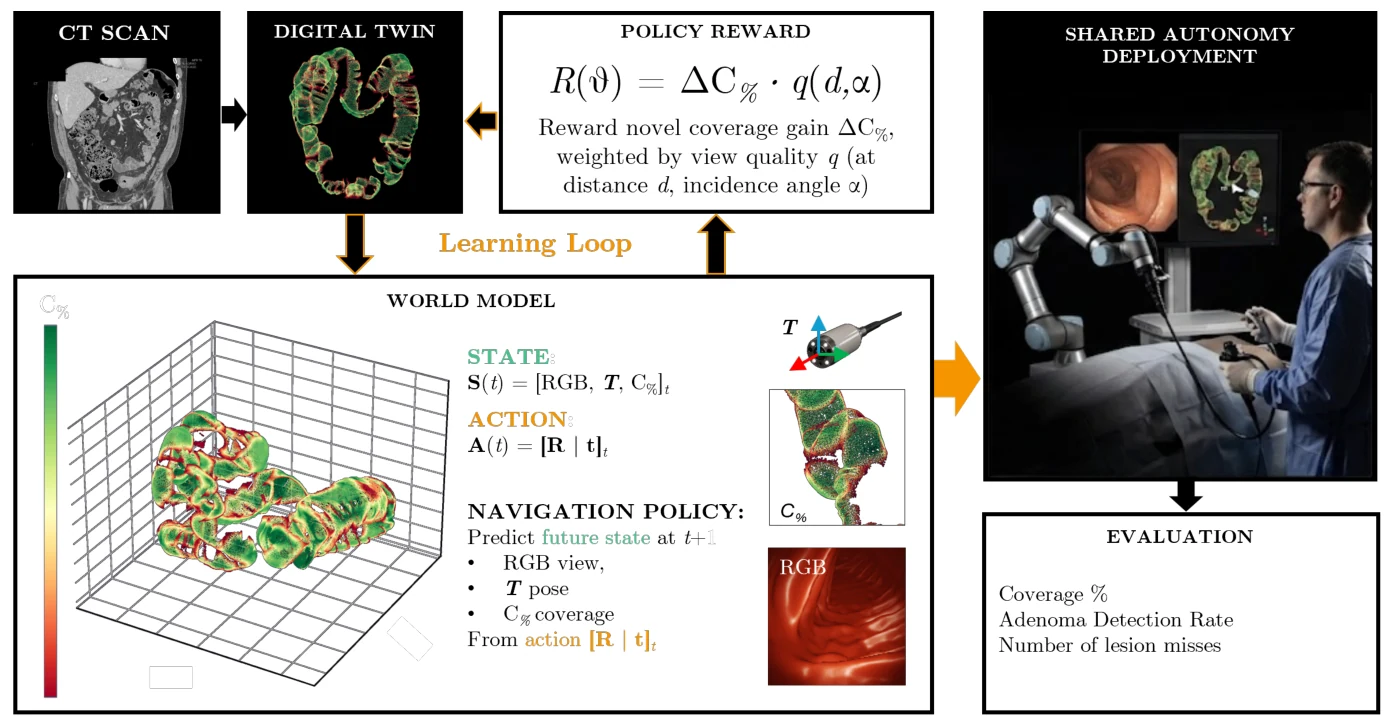
A patient's CT colonography scan is segmented into a patient-specific digital twin providing full surface geometry so mucosal coverage along any trajectory is exactly measurable. Inside the twin, a world model predicts the next state S(t) = [RGB, T, C%]ₜ (endoluminal view, camera pose, and cumulative coverage) from each candidate action A(t). A navigation policy is trained in a closed loop against reward R(θ) = ΔC% · q(d, α), crediting novel coverage gain ΔC% weighted by view quality q that penalizes large viewing distance d and oblique incidence angle α. The trained policy transfers to robotic shared-autonomy deployment on the live endoscopic feed with the clinician in the loop.
Results
The framework is evaluated by mucosal coverage percentage, ADR, and number of missed lesions, metrics aligned with the clinical failure mode of inadequate inspection. Beyond aggregate scores, the digital twin yields per-patient blind-spot maps localizing hard-to-visualize regions and coverage-optimal inspection plans tailored to each colon's anatomy, standardizing inspection quality and reducing operator dependence.
Conclusion
By reframing autonomous colonoscopy around mucosal coverage rather than caecal reach, patient-specific digital-twin world models directly target a root cause of interval cancers. The approach received the Best Poster Award at the Hamlyn Symposium workshop on Physics- and AI-Driven Digital Twins for Patient-Specific Robotic Diagnosis, Interventions and Therapies (sponsored by NVIDIA).
Collaborators
- Sofia Breschi
- Laura Cruciani
- Alessandra Marasi
- Nicola Ancellotti
- Leonardo Passoni
- Matteo Di Mauro
- Elena De Momi