UnReflectAnything
RGB-only highlight removal by rendering synthetic specular supervision
- image-to-image
- syntetic specular supervision
- venue
- CVPR 2026 ⋅ ORAL
- year
- 2026
Abstract
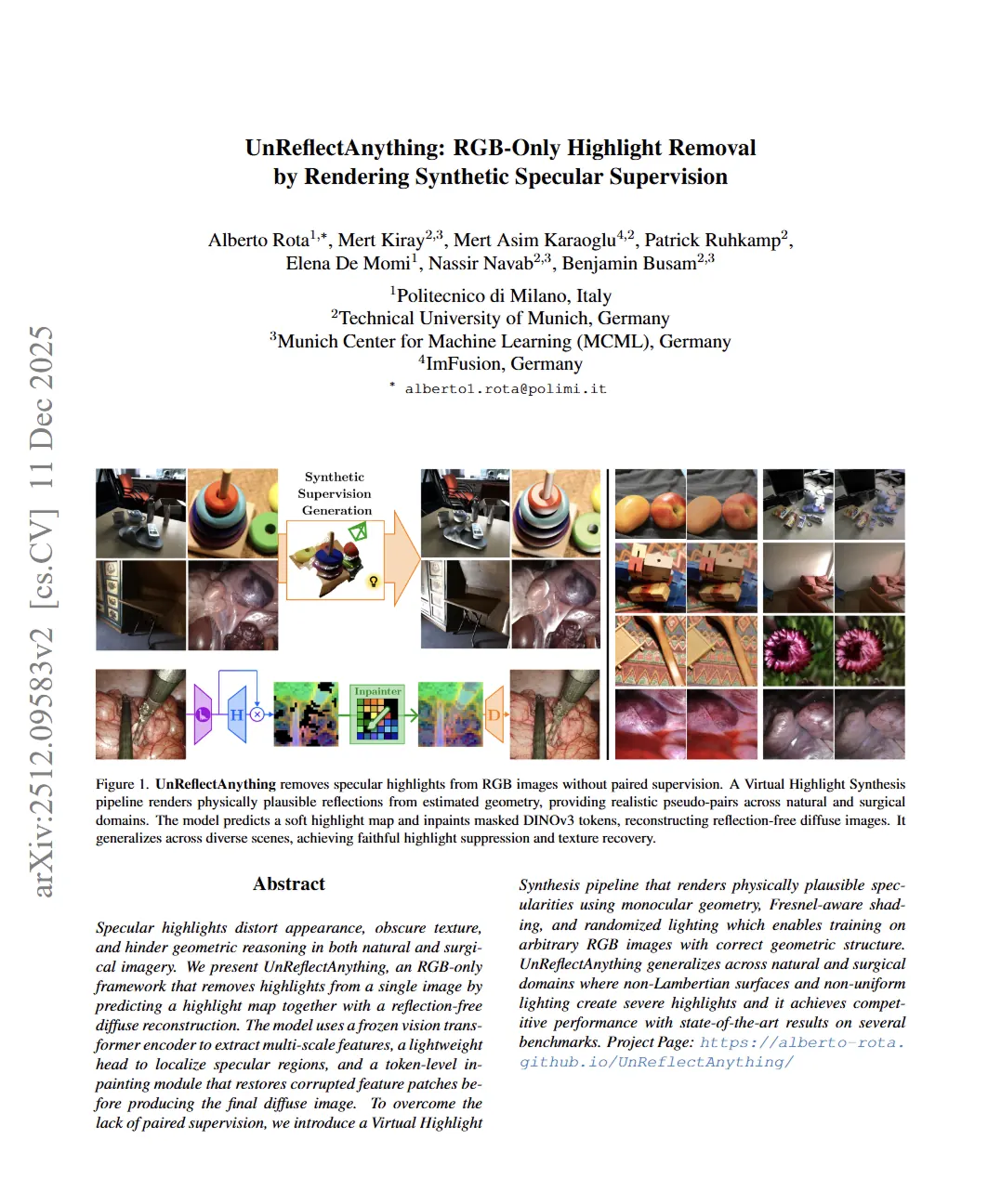
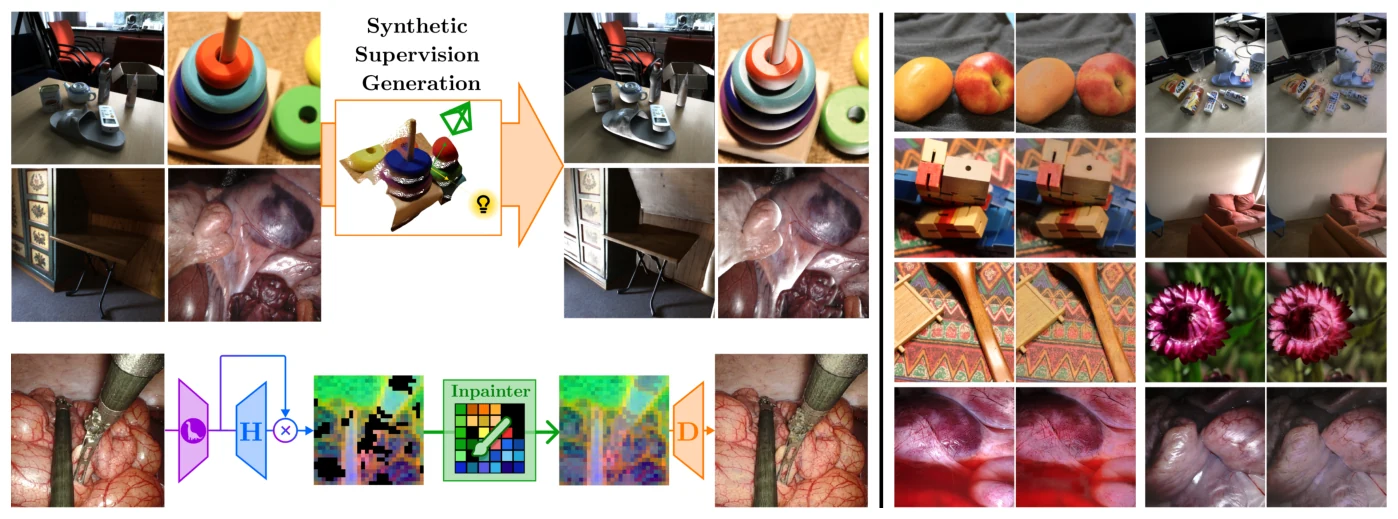
Specular highlights distort appearance, obscure texture, and hinder geometric reasoning in both natural and surgical imagery. We present UnReflectAnything, an RGB-only framework that removes highlights from a single image by predicting a highlight map together with a reflection-free diffuse reconstruction. The model uses a frozen vision transformer encoder to extract multi-scale features, a lightweight head to localize specular regions, and a token-level inpainting module that restores corrupted feature patches before producing the final diffuse image. To overcome the lack of paired supervision, we introduce a Virtual Highlight Synthesis pipeline that renders physically plausible specularities using monocular geometry, Fresnel-aware shading, and randomized lighting, enabling training on arbitrary RGB images with correct geometric structure. UnReflectAnything generalizes across natural and surgical domains and achieves competitive performance with state-of-the-art results on several benchmarks.
Introduction
Specular highlights arise from mirror-like reflections on non-Lambertian surfaces, producing saturated, view-dependent artifacts that obscure scene content and corrupt downstream perception tasks such as segmentation, correspondence, and photometric inference. In natural images, these highlights distort color fidelity and degrade restoration or relighting pipelines. In endoscopic scenes, bodily fluids, moist tissue, and strong non-uniform lighting introduce intense specularities that occlude anatomy, bias texture cues, and hinder navigation and decision-making. Such artifacts critically impair depth estimation, optical flow, and stereo reconstruction in surgical robotics, where accurate scene understanding is essential and visual ambiguity can carry clinical impact.
Methodology
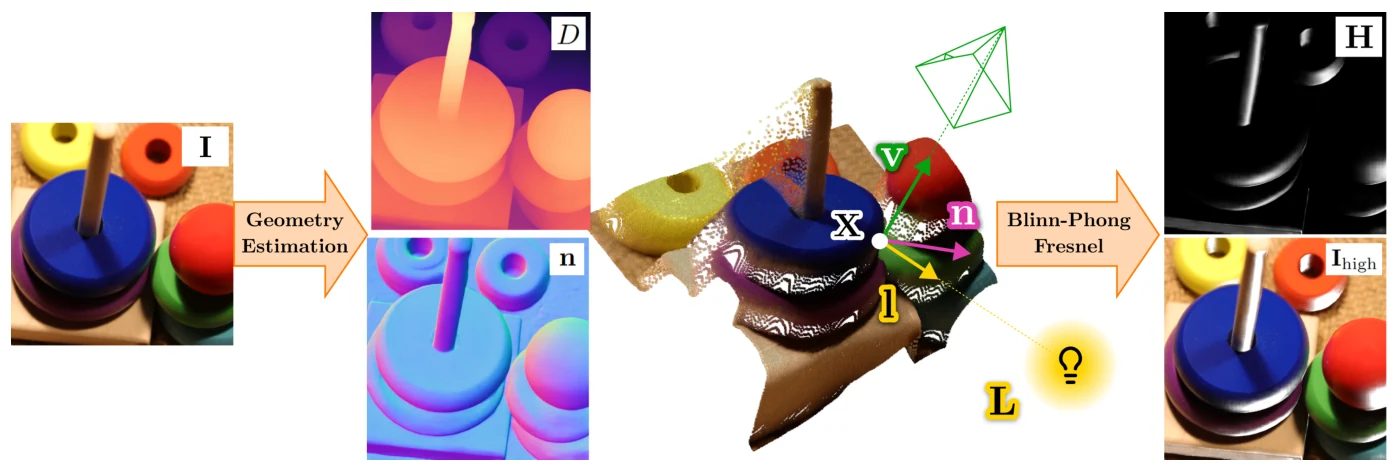
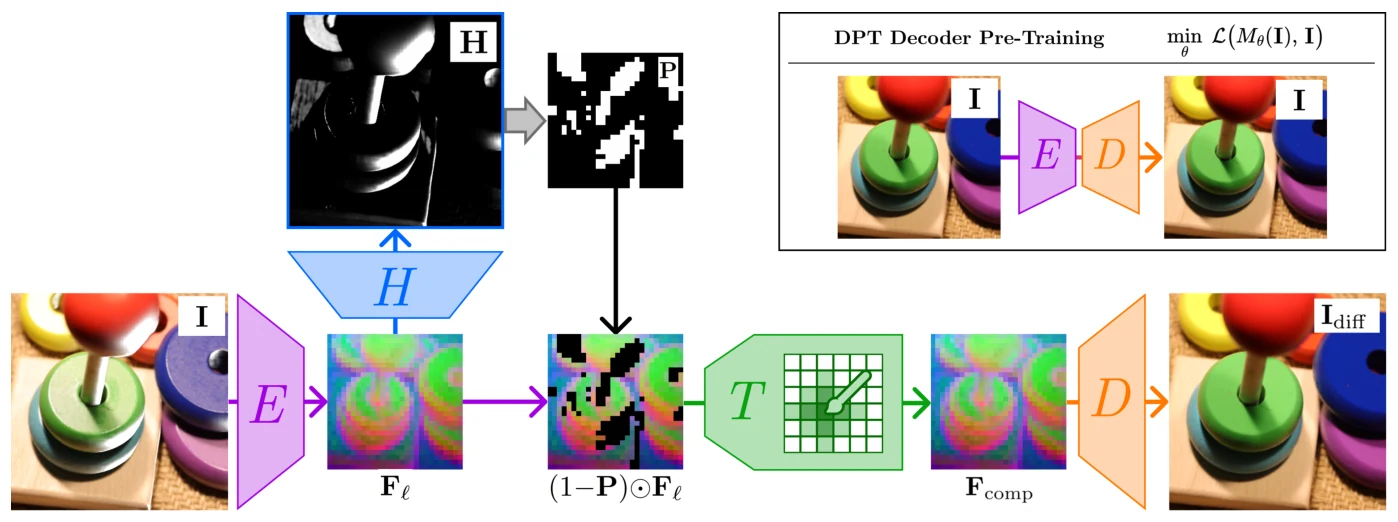
We integrate physically grounded virtual highlight synthesis with token-space inpainting to recover reflection-free images from a single RGB view. Given an input image, monocular geometry is estimated to obtain metric depth, surface normals, and intrinsics; a point light is sampled in camera space and a Blinn–Phong lobe with Fresnel modulation renders synthetic specularities on top of the real image, producing paired supervision without multi-view capture or polarization. A frozen ViT encoder extracts multi-scale features; a DPT-based highlight head localizes specular regions, corrupted tokens are inpainted, and a diffuse decoder reconstructs the reflection-free output. The full pipeline is trained end-to-end on synthetically highlighted images and transfers to unseen real domains at inference.
Results
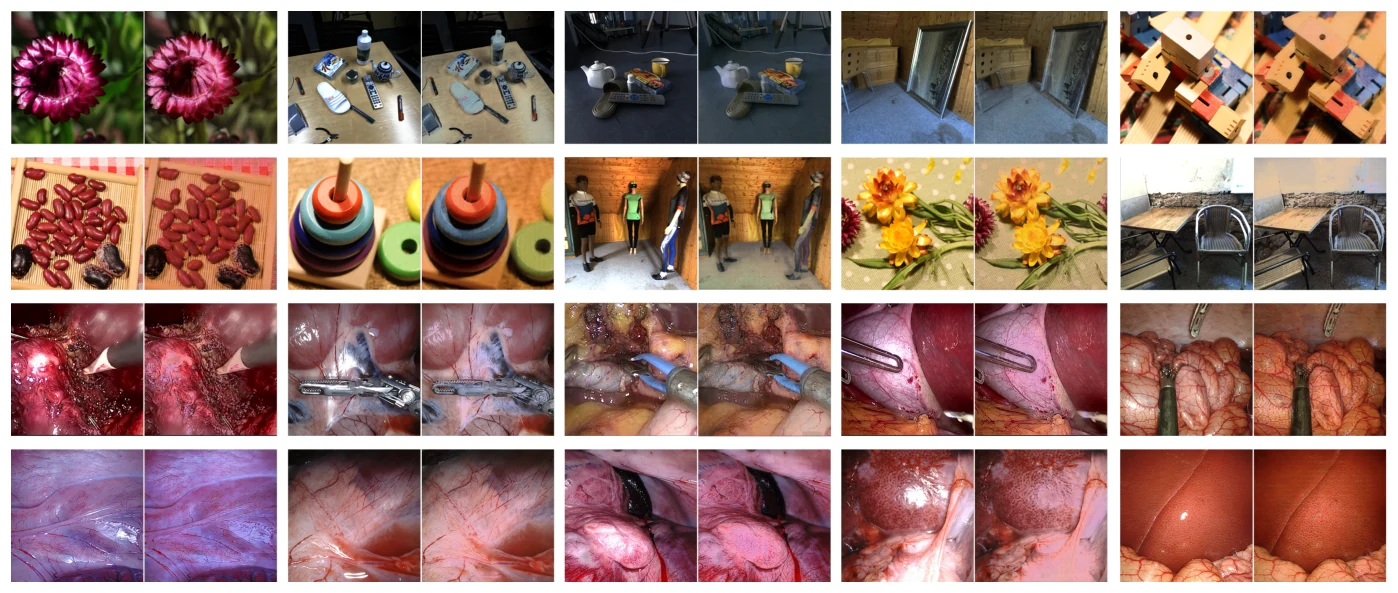
UnReflectAnything is evaluated on datasets with paired diffuse-only ground truth (PSD, SHIQ, SSHR) and on surgical endoscopy, where it consistently suppresses and attenuates specular highlights while preserving structure. Across natural-scene benchmarks it matches or exceeds state-of-the-art diffusion and physics-based baselines on MSE, PSNR, and SSIM, and in challenging endoscopic scenes it avoids the over-dimming and residual highlights common to diffusion methods. Ablations confirm the contribution of virtual highlight synthesis, token inpainting, and the Fresnel-aware rendering model. The feedforward architecture runs in real time on a single consumer GPU, making deployment more plausible than iterative diffusion alternatives.
Conclusion
UnReflectAnything demonstrates that RGB-only highlight removal is feasible when training is driven by physically plausible synthetic supervision rather than paired real captures. The framework generalizes from natural images to surgical endoscopy, where conservative reconstruction over hallucination is clinically desirable. Remaining limitations include reduced reliability on transparent or refractive objects, where diffuse and specular components are difficult to separate; future work may extend the synthesis model to handle such materials.
Collaborators
- Mert Kiray
- Mert Asim Karaoglu
- Patrick Ruhkamp
- Elena De Momi
- Nassir Navab
- Benjamin Busam