STEVE
Augmented training curriculum for surgical robotics
- Unity
- C#
- da Vinci Research Kit
- venue
- ICRA 2024
- year
- 2024
Abstract
High-level haptic assistance algorithms integrated into surgical robotics training may help aspiring surgeons build a more comprehensive skillset and improve clinical performance. This work presents a haptic-enhanced VR simulator for surgical robotics training with eight physics-based tasks, augmented by force-based guidance that redirects the trainee's hands toward targets or away from obstacles and provides quantitative performance scores. An experimental study shows that augmented assistance improves training performance and promotes skill transfer to unassisted scenarios resembling clinical teleoperation.
Introduction
The growth of robot-assisted minimally invasive surgery demands trained surgeons capable of teleoperating complex systems safely. Haptic assistance (HA) at the leader manipulator can redirect hand motion through forces and torques, potentially accelerating skill acquisition in virtual training environments where tasks are customizable and performance quantifiable. This work studies HA in the context of a structured curriculum paired with the da Vinci Research Kit, evaluating whether assisted training improves both in-simulation performance and transfer to novel unassisted tasks.
Methodology
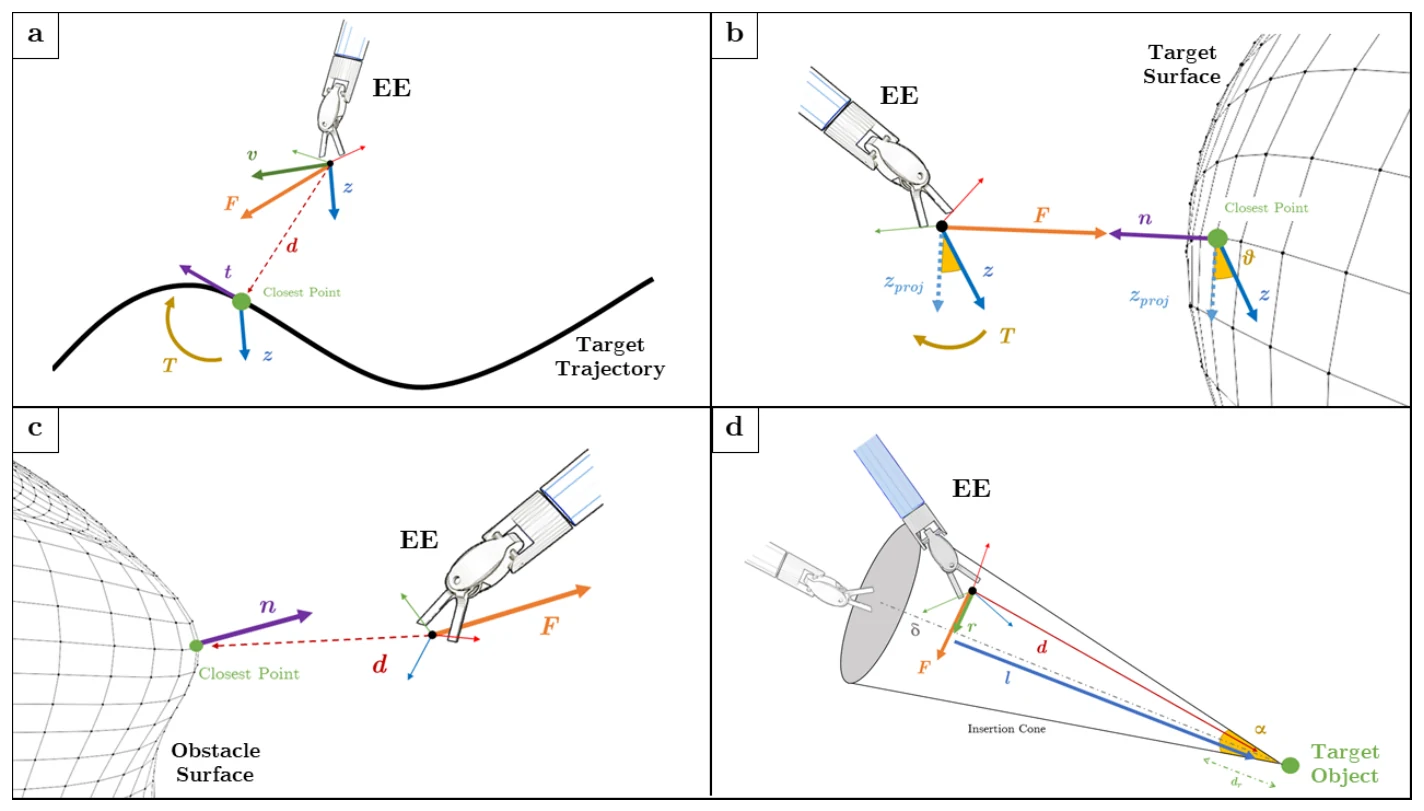
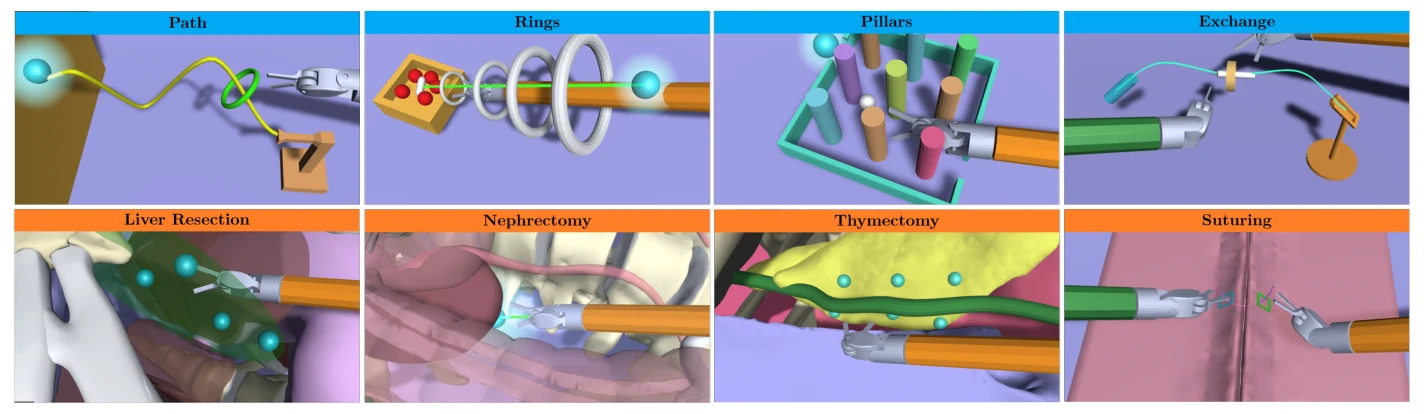
STEVE implements four HA strategies (trajectory guidance, obstacle avoidance, surface guidance, and insertion guidance) as visco-elastic force/torque fields on the master manipulators. Eight Unity tasks span training (Path, Rings, Pillars, Exchange) and evaluation (Liver Resection, Thymectomy, Nephrectomy, Suturing) scenarios targeting wrist articulation, depth perception, hand-eye coordination, and bimanual exchange. Performance P is a task-weighted combination of distance error, angular error, force/torque magnitudes, instrument drops, and repositioning time, normalized to expert execution. Eight novice subjects were randomized to assisted or control groups: four days of thrice-daily assisted or unassisted training, two rest days, then unassisted evaluation on unseen tasks.
Results
During training, the assisted group consistently outperformed controls across all four training tasks with improving trends over repetitions. On day-7 evaluation tasks, executed without assistance by both groups, assisted subjects achieved higher median performance on Thymectomy (+13.07%), Liver Resection (+21.54%), and Suturing (+8.44%), with only Nephrectomy showing a slight decrease (−2.71%). The results suggest HA during training improves unassisted performance on novel surgical-like tasks, supporting skill transfer through integrated visuo-haptic feedback during teleoperation.
Conclusion
Haptic-enhanced VR training on a surgical robot simulator improves task performance during assisted practice and may transfer to unassisted clinical-like scenarios. Extensions include adaptive visco-elastic parameters, larger cohorts, and long-term retention studies. STEVE provides an open hardware/software stack for replicating augmented surgical robotics curricula.
Collaborators
- Ke Fan
- Elena De Momi